Aliph Solutions

Proposal management

Give every opportunity a considered response.

Explore a controlled RFP workflow from intake and qualification through response drafting, coverage, pricing review, submission approval and outcome learning.

Illustrative Saudi proposal team reviewing a folded plan around an oak project table
The opportunity

Keep the requirement visible as the response takes shape.

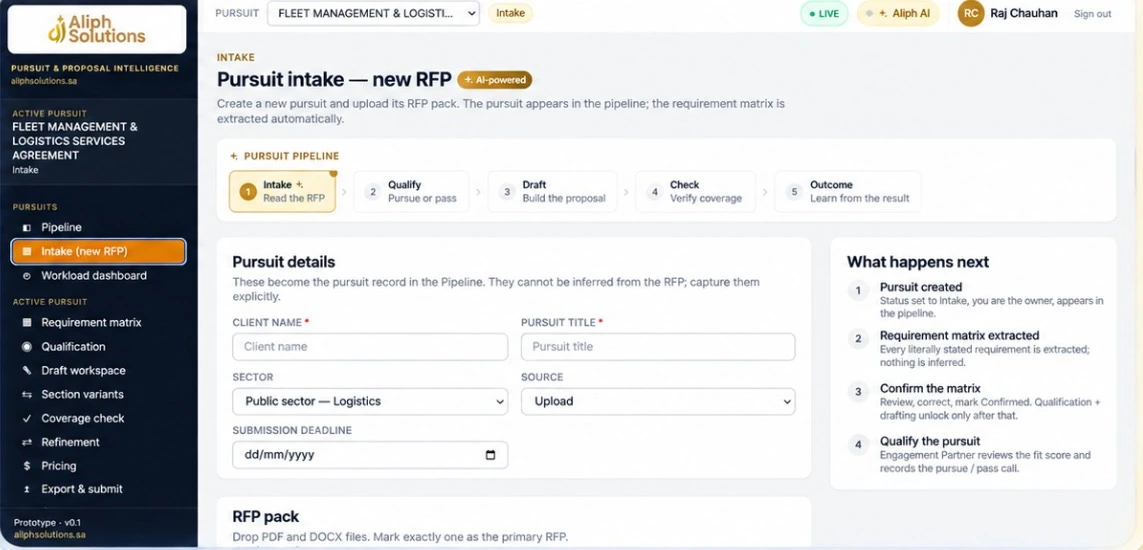
The Pursuit & Proposal Intelligence product preview connects the RFP pack to a controlled response workflow. Extract and confirm the requirement matrix, qualify the opportunity, draft sections and review coverage and pricing. Named reviewers approve commitments and retain export and submission authority. Outcome learning provides context for the next pursuit.

Reviewed tender intake

Organise the tender documents, amendments, response instructions and important dates. Extract candidate requirements for human confirmation, retaining the source reference and relevant context. Separate mandatory requirements from interpretation questions that need a qualification or clarification decision.

Accountable response development

Assign sections to owners and bring approved reference material into the drafting process. Distinguish reusable evidence from assumptions and proposed commitments. Keep the people who understand delivery, commercial terms and the customer need involved in the relevant review decisions.

Coverage, pricing and controlled submission

Review confirmed requirements against response sections and supporting evidence. Bring pricing and refinement decisions through the assigned commercial review. Record who approves exceptions, authorises export and submits the response. Capture the outcome and approved learning points for subsequent pursuits.


Illustrative scenario

Review a tender with several contributing teams.

A proposal manager receives an enterprise services tender with separate technical and operating requirements. The team confirms a requirement matrix, assigns response sections and uses approved project descriptions to prepare drafts. An amendment changes a delivery requirement, prompting a review of the affected sections and assumptions.

The evaluation checks whether the changed requirement can be traced to its responses, whether every mandatory item has an owner and whether reviewers can identify commitments that still need approval. The scenario uses an illustrative tender.

Saudi colleagues coordinating work around a meeting table
Illustrative imagery accompanying a proposed workflow.
A practical path

From a defined need to a working process.

Use a representative tender to explore the Pursuit product preview. Confirm the requirement matrix, qualification and pricing decisions, response coverage and the authority needed for export or submission.

01

Review a recent pursuit

Understand intake, qualification, drafting and approval using a representative completed tender. Identify where ownership, evidence or requirement coverage became difficult to follow.

02

Define the response structure

Agree requirement types, section ownership and review gates. Select the reference material that may support a response and record how commitments are approved.

03

Test the working process

Run the workflow against a representative tender, including an amendment, a missing reference and a requirement the organisation cannot currently satisfy.

04

Support the proposal team

Prepare contributor guidance, pricing and coverage checks, export authority and ownership for reusable content. Capture the outcome and review which learning points should inform the next pursuit.

What to evaluate

Check requirement coverage, unresolved questions and reviewer effort against a representative tender and your current process.

Frequently asked questions

Plan the next step with a clearer picture.

Will AI write and submit a proposal automatically?

The scope centres on reviewed intake, drafting and coordination. Contributors remain responsible for factual accuracy and authorised reviewers approve commitments. Submission permissions and any external actions must be explicitly agreed; they are not assumed.

How do we handle confidential tender material?

Identify document sensitivity, intended users and permitted processing arrangements during discovery. Confirm access and hosting requirements before loading material. The proposed workflow should show where tender content and response drafts will be used.

Can we reuse answers from previous proposals?

Select content that is still approved, accurate and relevant. Record its owner and the circumstances in which it may be reused. Past wording should be treated as a starting point for review, especially when scope or commitments have changed.

What should a successful first pilot demonstrate?

Use a representative tender to assess requirement coverage, source traceability, unresolved questions and reviewer effort. Agree the baseline and acceptance criteria with the proposal team before the pilot so useful progress can be distinguished from fluent drafting.

MAKE IT WORK

Give your proposal team a clearer process.

Tell us about your current process, intended users and requirements. We’ll help define a first implementation and a practical way to evaluate it.

Start a conversation

Ask Aliph

Aliph products and services

Find your next step with Aliph.

Ask about a product, compare capabilities or explore how our services can support your team.

Enter to send · Shift+Enter for a new line0 / 1,000

Messages are processed by AI. Don’t share confidential information. Answers can be inaccurate. Privacy

This page keeps chat history in memory only.Talk to our team