Aliph Solutions

Governance & assurance

Turn governance into connected work.

Connect governance inventory, policy gaps, enterprise risks, indicators, controls and assurance through one reviewed evidence lifecycle.

Illustrative pale stone frames surrounding an amber glass core, connected by cobalt rails
The opportunity

Connect the record to the person responsible for it.

Aliph GRC implements governance in software on customer-approved infrastructure. A common evidence lifecycle connects requirements, risks, controls, tests, findings, actions and reporting. Policy Vault manages the governance inventory and document lifecycle, while Aliph Risk & Compliance provides the core register and Enterprise Risk capability. Named owners review the evidence and accept decisions.

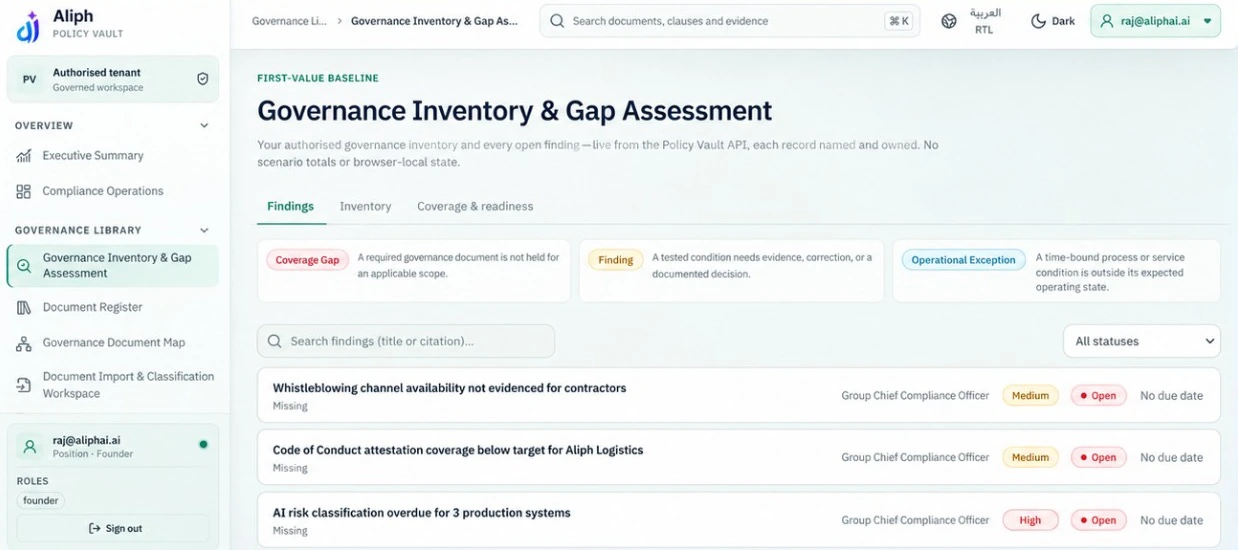
Governance inventory and policy assurance

Use Policy Vault to inventory and classify governance documents, map relationships and identify coverage gaps. Connect draft, review, approval, publishing and attestation with named owners. Readiness views support the review of evidence and outstanding work; they do not establish a certification.

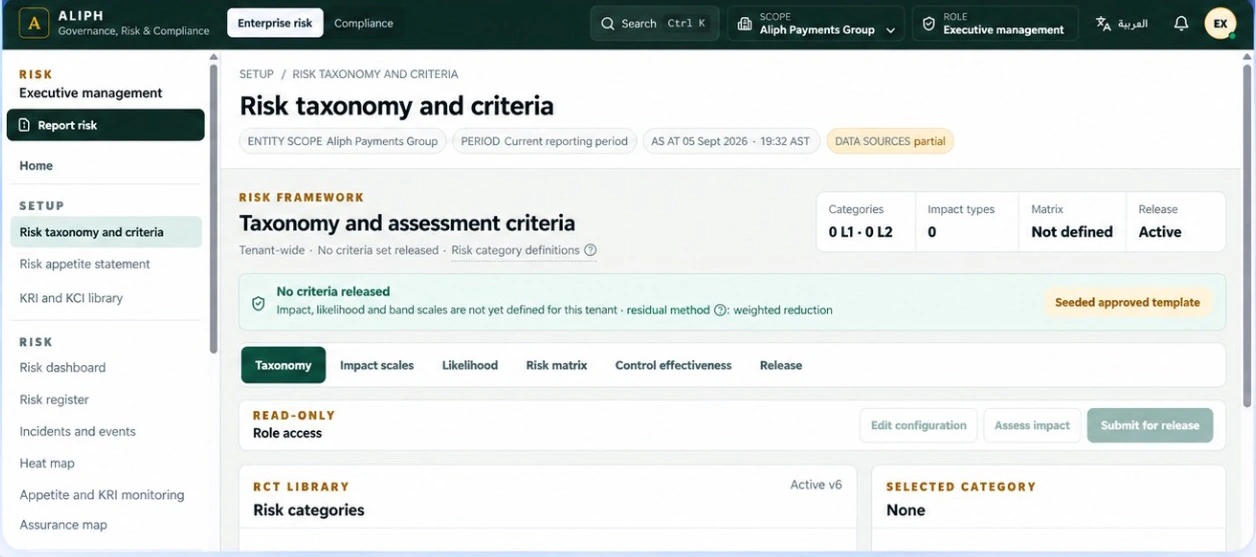
Enterprise Risk and control assurance

Establish the risk taxonomy, impact and likelihood scales, appetite and relevant KRIs and KCIs. Connect incidents, control effectiveness, assessments and actions to the core register. Heat maps and assurance views reflect the agreed methodology and supporting records.

Evidence that supports reviewed reporting

Follow a requirement through the relevant risks, controls, tests, findings and actions. Define closure evidence and the route for overdue decisions. Agentic Studio can draft assessments and board reporting from governed register records, with named owners reviewing the material before approval.


Illustrative scenario

Follow a control review from evidence to closure.

A governance team reviews a periodic user-access control. The control owner supplies the review record, an assessor identifies accounts requiring follow-up and the team records a finding with a responsible action owner. A reviewer checks the supporting material before accepting closure.

The walkthrough tests whether each participant can complete their step, whether the evidence supports the recorded decision and whether an overdue action reaches the right person. Reviewers use the findings to refine the proposed workflow.

Saudi business colleagues discussing a shared review at a meeting table
Illustrative imagery accompanying a proposed workflow.
A practical path

From a defined need to a working process.

Choose one policy, risk or assurance cycle. Agree the document inventory, risk methodology, register relationships and named review authorities before configuring the workflow.

01

Map the operating process

Choose one policy, assessment or assurance cycle. Document the current records, decisions, participants and handoffs before selecting what to configure.

02

Agree the record model

Define the relationships between obligations, policies, risks, controls and evidence within scope. Confirm ownership, review authority and meaningful status values.

03

Configure and walk through

Implement the agreed registers and approval steps. Use a representative case to test rejected evidence, reassigned ownership and an overdue action.

04

Prepare the next cycle

Confirm reporting responsibilities, review calendars and data maintenance. Give owners a clear method for changing the workflow as the operating model evolves.

What to evaluate

Review whether owners can complete their work, reviewers can follow the evidence and unresolved actions reach the right decision-maker.

Frequently asked questions

Plan the next step with a clearer picture.

Do we need to replace every existing register?

No. Begin with the process where disconnected records create the most difficulty. During discovery, identify what should be retained, connected or migrated. The implementation scope should make the authoritative record and its owner clear.

Will software establish compliance for us?

A system can organise records, responsibilities and review decisions. Your accountable teams still determine which requirements apply, assess the evidence and approve conclusions. The engagement should define the process and responsibilities needed to support that work.

Can the workflow follow our existing methodology?

Use the current assessment criteria, approval roles and reporting requirements as design inputs. Where terminology or handoffs are unclear, resolve them with the process owner before configuration and validate the result with a representative case.

How should we measure improvement?

Choose measures connected to the workflow: completeness of ownership, evidence quality, time spent resolving a review question and visibility of outstanding actions. Record a baseline and use the same definitions when reviewing the first cycle.

MAKE IT WORK

Connect your next governance workflow.

Tell us about your current process, intended users and requirements. We’ll help define a first implementation and a practical way to evaluate it.

Start a conversation

Ask Aliph

Aliph products and services

Find your next step with Aliph.

Ask about a product, compare capabilities or explore how our services can support your team.

Enter to send · Shift+Enter for a new line0 / 1,000

Messages are processed by AI. Don’t share confidential information. Answers can be inaccurate. Privacy

This page keeps chat history in memory only.Talk to our team