Aliph Solutions

Enterprise knowledge

Make what you know easier to use.

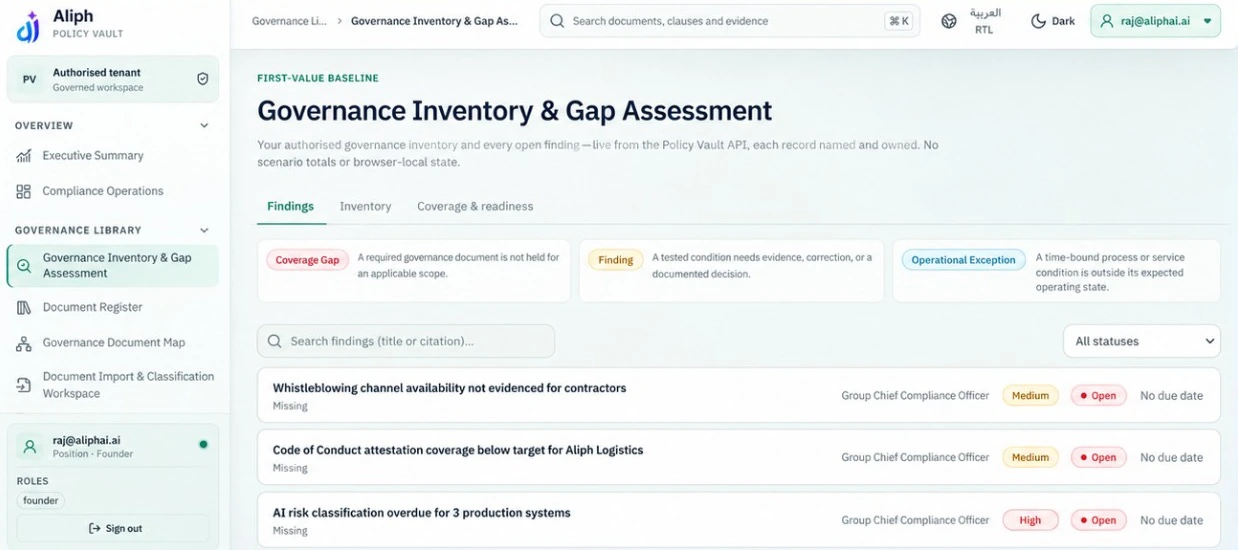
Connect approved ERP, CRM, policy and GRC records through source-attributed organisational memory, with Arabic and English context people can review.

Illustrative sunlit Riyadh library with oak shelves, geometric shadows and a laptop on a reading table
The opportunity

Help people find the answer and understand its source.

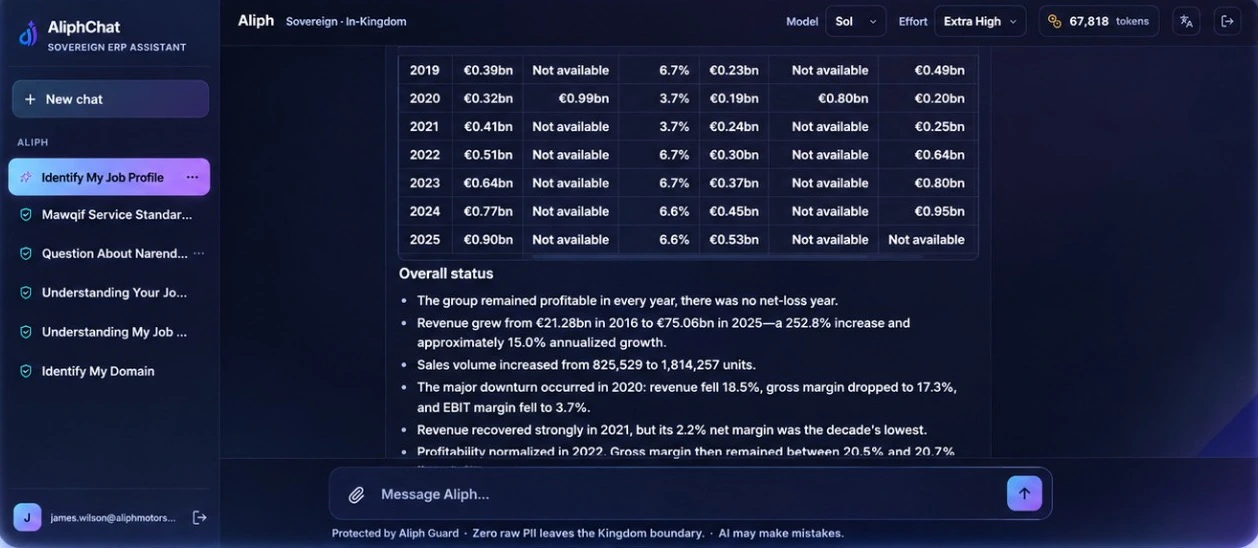
An enterprise question can span ERP transactions, CRM activity, policies and GRC records. AliphChat brings approved sources into a conversational front door, with organisational memory and source attribution. Aliph Data establishes the ownership, classification and purpose behind that memory. Shape the scope around the business question, approved connectors and Arabic or English context the user needs.

Connected enterprise context

Select the approved ERP, CRM, policy and GRC sources needed for the task. Scope connectors and synchronisation, including Zoho where relevant, with source owners. Preserve record identifiers, document versions and permissions so analysis and executive insight remain attributable to information a reviewer can inspect.

Answers people can review

Use AliphChat to connect a question with its source records, context and relevant analysis. Include Arabic and mixed-language examples in the evaluation. A compliance question needing a structured deliverable can move into the distinct AI Consultant workflow, using supplied context, guided clarification and specialist review.

An operating model for changing knowledge

Plan how approved updates become available, how withdrawn material is removed and who investigates poor answers. Evaluate access boundaries alongside answer quality. Give source owners a repeatable way to correct the knowledge base as questions, policies and users change.


Illustrative scenario

Find the right operational guidance.

An employee needs to understand the steps for requesting access to an internal system. A scoped assistant retrieves the approved access procedure, identifies the request channel and presents the relevant passage. When the employee asks whether their individual request will be approved, the response directs them to the authorised reviewer.

The review checks whether the right procedure was retrieved, its version was current and the employee could identify the next step. It also checks that information outside the employee’s access was not exposed.

Saudi technology colleagues reviewing information at a workstation
Illustrative imagery accompanying a proposed workflow.
A practical path

From a defined need to a working process.

Choose one business question, the approved ERP or CRM records and the policies that support it. Confirm source ownership, classification, connector scope and access before evaluating the conversation.

01

Define the questions

Collect representative questions, current search habits and common dead ends. Agree the users, the knowledge domain and the situations that require escalation.

02

Prepare the sources

Confirm ownership, classification, purpose, access and refresh needs. Scope the ERP or CRM connectors and document sources, then record the source relationships and privacy transformations the experience needs to preserve.

03

Build and evaluate

Test retrieval and responses against a reviewed set of questions, including missing answers, conflicting documents and requests outside the intended scope.

04

Enable the team

Introduce the experience to a bounded user group. Review feedback with source owners and agree a process for updates, investigation and expansion.

What to evaluate

Evaluate whether answers are supported by the right sources, permissions are respected and employees can complete the intended task.

Frequently asked questions

Plan the next step with a clearer picture.

Does all our knowledge need to be ready before we start?

No. A bounded library with a clear owner is a practical starting point. Include enough representative material to test the intended task, then use the evaluation to decide which sources or questions to add next.

What happens when sources disagree?

Agree a source precedence and escalation approach during design. A useful experience should surface the conflict or direct it to an owner, rather than silently treating one version as authoritative. Conflicting documents also become a knowledge maintenance action.

Can we include Arabic and English material?

Language requirements should be part of the scope and evaluation set. Bring examples in each language, including mixed-language queries and terminology. Retrieval, source display and response quality need to be evaluated with reviewers who understand the content.

How do we choose a hosting arrangement?

Assess the proposed data flows, users, source systems and operating responsibilities together. Hosting, model selection and integration scope are design decisions that should be confirmed against the organisation’s requirements before implementation.

MAKE IT WORK

Make your knowledge easier to use.

Tell us about your current process, intended users and requirements. We’ll help define a first implementation and a practical way to evaluate it.

Start a conversation

Ask Aliph

Aliph products and services

Find your next step with Aliph.

Ask about a product, compare capabilities or explore how our services can support your team.

Enter to send · Shift+Enter for a new line0 / 1,000

Messages are processed by AI. Don’t share confidential information. Answers can be inaccurate. Privacy

This page keeps chat history in memory only.Talk to our team