
Establish the permitted use
Identify the task, data owners, source collections and classification. Agree purpose, access and the processing environment before preparing the material for AI.
Aliph Data
Establish ownership, classification and purpose; engineer Arabic and English privacy controls; and build attributable organisational memory with an approved, reversible learning cycle.

Aliph Data is the shared foundation for Aliph AI, GRC and Cyber. It establishes what an institution holds, who owns it and how it may be used before a model touches the data. Documents, decisions and records can then form a governed memory, with privacy transformations and learning decisions controlled inside the agreed environment.
For institutions preparing enterprise AI, protecting Arabic and English records, and building a governed organisational memory.
Inventory the selected data, identify its accountable owners and record the intended use. Agree classification, access, retention and permitted processing before model access. Turn those decisions into a source map and practical rules the implementation can enforce and evaluate.
Discover Arabic names, national IDs, Iqama numbers, Arabic addresses and mixed-script records alongside English fields. Engineer transformations for the intended use, such as masking, redaction or tokenisation where appropriate. Test detection and transformed outputs against representative institutional material.
Prepare documents, decisions and business records as a searchable memory the institution owns. Preserve source attribution, approval status, permissions and freshness. Give source owners a way to update or withdraw material, so an answer can be traced to the records available to that user.
Use authorised institutional data to evaluate and improve approved open-weight models where the deployment scope includes training or adaptation. Separate usable memory from approved training data. Record the data, configuration, evaluation and owner decision for each release, with a tested route to rollback.
A source entering organisational memory does not automatically become training material. Purpose, classification and permission determine what each stage may use.
An institution holds Arabic procedures, English operational records and mixed-script forms containing personal identifiers. The team assigns owners and purpose, discovers sensitive fields and validates the selected transformations. Approved material enters a source-attributable memory with access and freshness controls.
In this illustrative scope, reviewers test useful answers and privacy exceptions before access expands. A later model-improvement proposal uses only separately approved data and follows the evaluate, approve, release and rollback cycle.

Agree the scope, responsibilities and acceptance criteria together. The delivery plan brings business context, implementation and review into the same conversation.
Identify the task, data owners, source collections and classification. Agree purpose, access and the processing environment before preparing the material for AI.
Review Arabic and English records, including names, national identifiers, Iqama fields, addresses and mixed script. Implement and test the transformations required by the approved use.
Preserve source identity, context, permissions and refresh expectations as material is prepared for retrieval. Validate attribution and give owners an update and withdrawal process.
Document the operating model and, where included, the approved learning workflow. Evaluate changes, capture owner approval and practise the release and rollback steps.
Deliverables are confirmed in the agreed scope. They can include:
These inputs help turn an initial discussion into a focused scope.
Validate sensitive-field discovery and transformation, source attribution, access and freshness. For model improvement, confirm that evaluation evidence, owner approval, release history and a tested rollback route accompany the change.
AliphChat uses approved organisational memory to support attributable conversations. Aliph Risk & Compliance connects governed records with ownership and evidence. Source preparation and integration scope are agreed for each implementation.
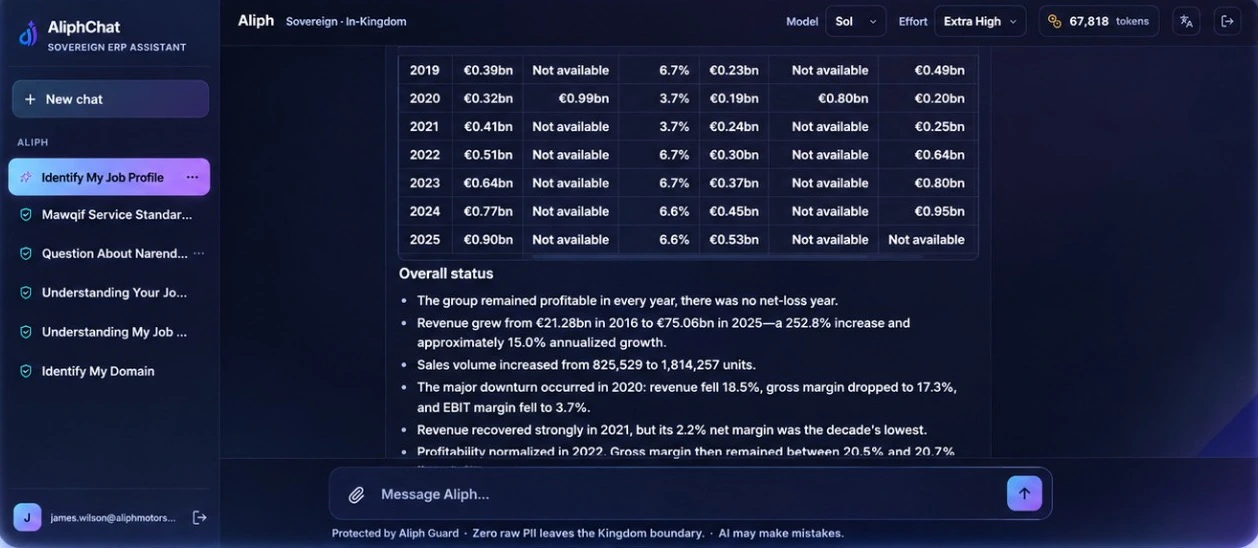
Bring ERP, CRM, policies and organisational memory into one conversation. AliphChat helps your teams understand what is happening, check the information behind the answer and decide what to do next across the business.
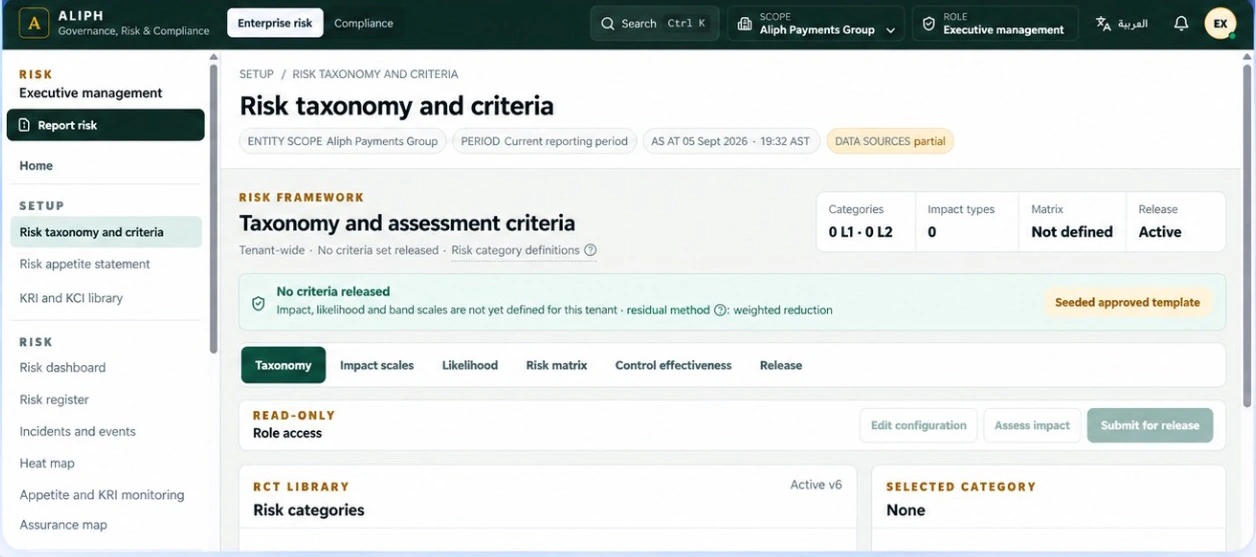
Bring risk appetite, control performance and assurance into one connected view. Aliph Risk & Compliance helps teams explain the exposure, follow the evidence and put the next action in the right hands across the institution.
Aliph AI draws on approved sources and model-ready data. Aliph GRC uses ownership and attribution to connect evidence to decisions. Aliph Cyber uses classification and privacy transformations to govern what an AI workflow may disclose. Aliph Data can begin as a standalone readiness engagement or form the foundation of a connected implementation.
The design and test material includes Arabic names, national IDs, Iqama numbers, addresses and mixed-script records. Discovery and transformation are evaluated against those patterns and their business context, including examples where the same field appears in different forms.
No. Retrieval memory and training data have separate purposes and approval decisions. Indexing an approved document makes it available only within the agreed retrieval scope. Model improvement requires its own authorised data set, evaluation and owner approval.
They run within the environment and deployment profile agreed with the institution. Customer-controlled and approved in-Kingdom arrangements can be designed for the scope. Any isolation, external processing or transfer requirement is resolved before the relevant data path is enabled.
Yes. A standalone readiness engagement can establish ownership, classification, purpose and privacy controls for a selected source set. The resulting foundation can then support an assistant, a GRC workflow or another approved institutional use.
Bring a source collection, a proposed use and the people responsible for the data. We’ll define the privacy, memory and readiness work it needs.
Start a conversation