
Monitoring and triage
Review agreed telemetry and alerts, establish triage criteria and identify the events that need investigation or an owner decision.
Aliph Cyber
Engineer authority boundaries, egress protection, exchange and action logs, and adversarial tests for AI, with Arcova-supported security operations in the customer’s agreed environment.

Aliph Cyber brings security engineering into the AI systems and agents an institution deploys. Aliph leads the architecture, AI controls and evidence design. Our specialist partner Arcova supports the security operations scope, connecting monitoring and triage with investigation, response, exposure management and recovery exercises.
For institutions running models, enterprise assistants and agents that need explicit authority, controlled data movement and a prepared response.
Map users, sources, models, agents and tools across the customer’s approved environment. Define authority and data boundaries around the business task. Aliph engineers the AI control layer and the evidence needed to understand decisions, investigate behaviour and review changes.
Connect classification and Arabic/English privacy transformations to the paths that can send data to a model or external service. Design exchange and action logging with access, retention and sensitive-content handling agreed, so evidence supports investigation without creating an uncontrolled data collection.
Test prompt injection, unsupported access, sensitive-data disclosure and agent actions beyond the authorised task. Include Arabic, dialect and mixed-script cases where relevant. Run agreed regression tests when prompts, models, sources, permissions or tool integrations change.
Connect Aliph’s AI engineering and evidence design with Arcova’s specialist security operations support. The agreed service can include monitoring, triage, investigation, escalation, incident response, exposure management, remediation validation and practical recovery exercises.
These engineering capabilities are developed and implemented within an agreed system scope. Each control has a defined owner, operating purpose and validation method.
Aliph’s AI security control layer is being developed and implemented through scoped customer engagements. Define the control set, supported integrations and deployment requirements for your environment. Product packaging, availability and licensing terms are discussed as part of that engagement.
Aliph remains responsible for the agreed design, AI layer and evidence architecture. Arcova supports specialist operational delivery inside the customer’s agreed environment, using customer-owned or customer-approved tooling and documented authority.
Review agreed telemetry and alerts, establish triage criteria and identify the events that need investigation or an owner decision.
Follow incident playbooks, assemble relevant evidence and escalate within the authority granted by the institution. Define who can authorise containment or other consequential action.
Review the exposures most relevant to the institution’s systems and threat context. Prioritise findings with accountable technical and business owners.
Confirm whether agreed changes address the finding, preserve evidence of validation and identify residual work or control limitations.
Work through practical response and recovery scenarios, test the handoffs and record improvements to ownership, communications and restoration steps.
Connect operating records and control tests to the evidence requirements selected for the engagement. Review coverage and exceptions with the institution’s responsible assurance teams.
Service scope is subject to applicable registration, licensing and contracting requirements. Tooling, coverage, response authority and operating responsibilities are confirmed in the agreed engagement.
An institution wants an assistant to prepare a draft record in a business system. Aliph engineers the permitted action, approval step, egress rules and exchange/action logs. Adversarial tests exercise misleading source content, a sensitive identifier and an attempted action outside the approved remit.
In this illustrative engagement, Aliph and Arcova also define relevant alerts, triage and escalation. The customer owner decides whether the evidence supports release and which operational actions the response team is authorised to take.

Agree the scope, responsibilities and acceptance criteria together. The delivery plan brings business context, implementation and review into the same conversation.
Map the AI systems, data paths and business consequences. Confirm authorised testing, control owners, response authority and the applicable contracting and delivery requirements.
Implement the agreed authority checks, egress rules and exchange/action evidence. Connect the selected telemetry and operating responsibilities with the customer and Arcova.
Exercise adversarial cases, control tests and remediation checks. Review findings and evidence with the owners responsible for production acceptance and residual risk decisions.
Complete playbooks, handover and agreed operating coverage. Run response and recovery exercises, record lessons and define the changes that trigger another assessment.
Deliverables are confirmed in the agreed scope. They can include:
These inputs help turn an initial discussion into a focused scope.
Verify authority enforcement, egress behaviour, traceable exchanges and actions, and adversarial test results. Confirm response permissions, remediation evidence and recovery handoffs with the named institutional owners.
Agentic Studio supports reviewable workflows and draft reporting. Aliph Risk & Compliance connects controls, tests, findings and actions. The Cyber service adds scoped security engineering and operating responsibilities around the selected environment.
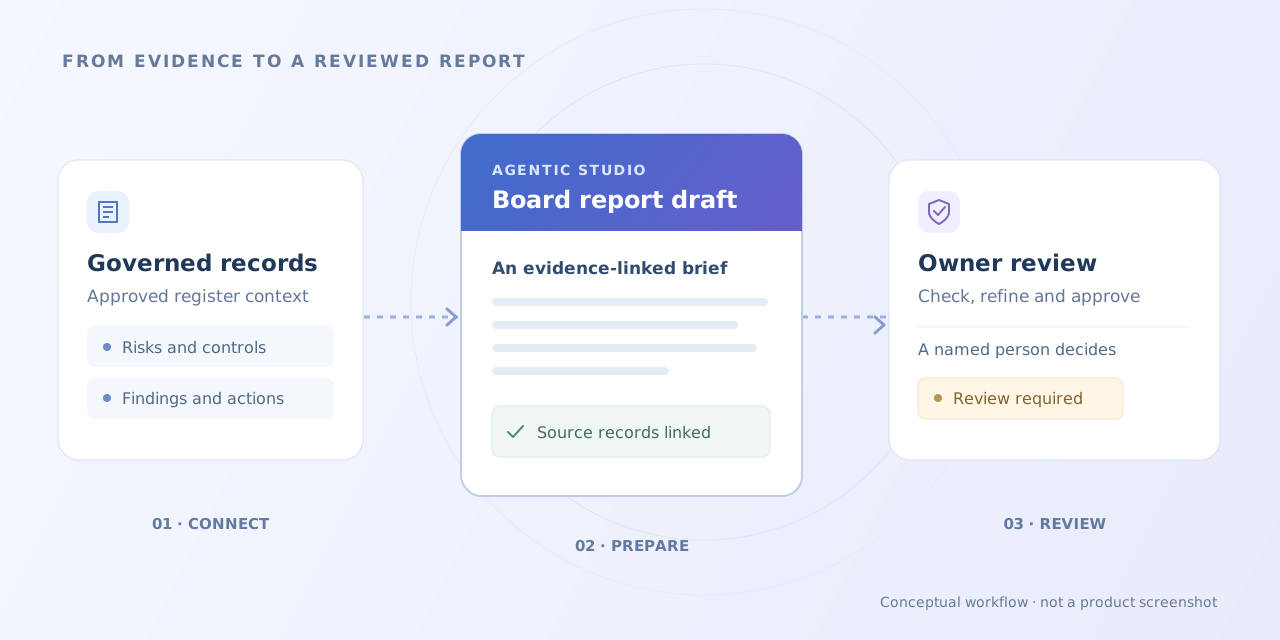
Start with the records your governance team already maintains. Agentic Studio prepares assessment, board report and regulatory submission drafts, giving reviewers the evidence, open questions and approval path they need to make the report their own.
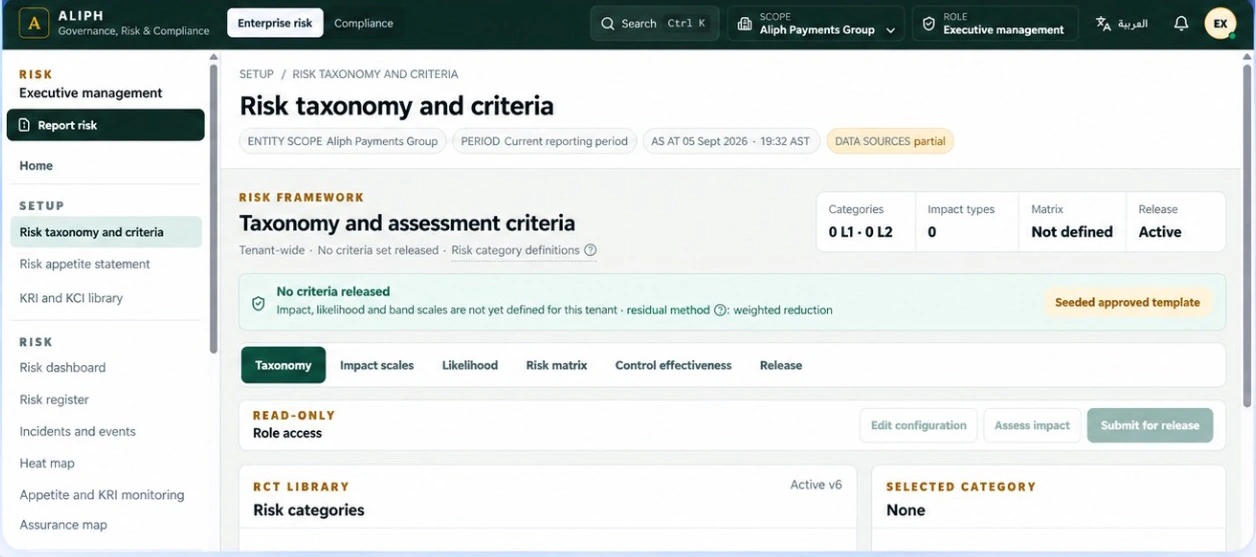
Bring risk appetite, control performance and assurance into one connected view. Aliph Risk & Compliance helps teams explain the exposure, follow the evidence and put the next action in the right hands across the institution.
Aliph Data supplies the classification and privacy transformations that inform egress rules. Aliph AI builds the application and agent behaviour those rules protect. Aliph GRC connects controls, tests, findings and treatment decisions to the institution’s evidence lifecycle. Select and map the applicable NCA baselines—ECC, CCC, DCC and OTCC—with the customer’s authorised teams. Connect each in-scope control to implementation records, testing and evidence for review.
The control layer is developed and implemented through scoped engagements. Bring the environment, model paths and agent actions you need to protect so we can discuss supported controls, integrations, availability and licensing terms for that scope.
Aliph leads the agreed design, AI controls and evidence architecture. Arcova supports specialist monitoring, triage, response, exposure and recovery activities within the contracted scope. The institution retains the approval and response authority documented for its environment.
The engagement can assess a proposed system regardless of who developed it, subject to authorised access and a workable integration scope. Discovery confirms the available data paths, interfaces, telemetry and permission controls before implementation commitments are made.
The customer’s authorised teams identify applicable obligations and baselines. Selected NCA ECC, CCC, DCC or OTCC requirements can inform engineering and evidence within the agreed scope. Mapping and testing support the institution’s review; they do not establish a blanket certification or compliance conclusion.
Share the AI systems, agents, data paths and operating concerns in scope. We’ll define the engineering controls, evidence and response responsibilities.
Start a conversation