Aliph Solutions

AI workflow automation

Automate with a purpose and a boundary.

Draft assessments, board reports and regulatory submission material from governed records, with named owners responsible for review and approval.

Illustrative overhead arrangement of a tablet and connected glass tiles, with one raised violet tile
The opportunity

Give repeatable work a clear route from input to approval.

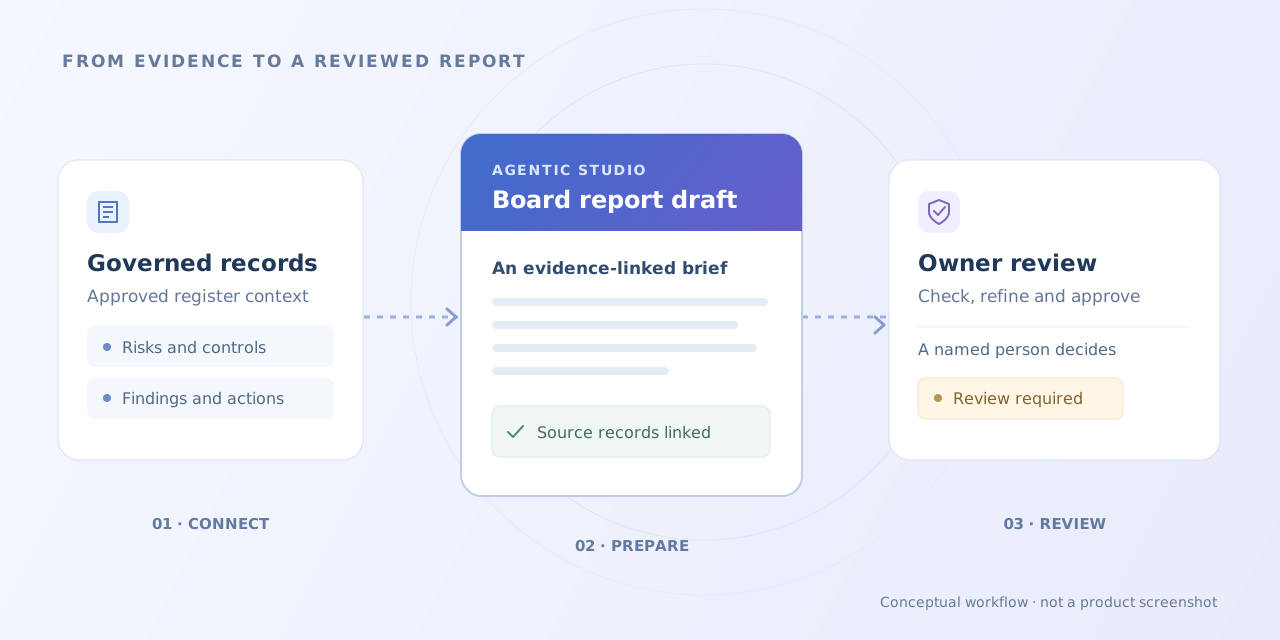
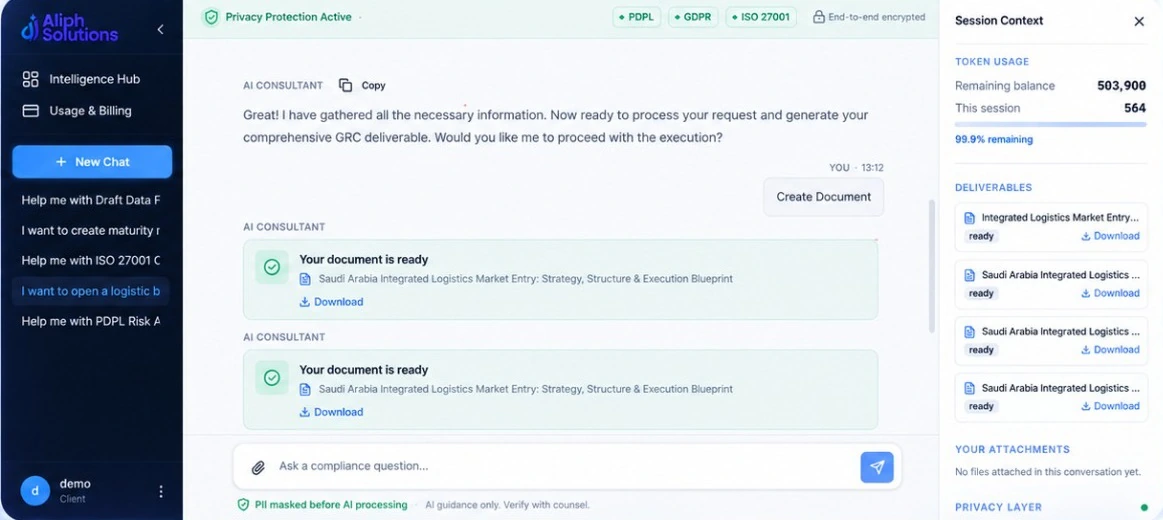
Agentic Studio prepares assessment, board-report and regulatory submission drafts from governed register records. The workflow connects source evidence to a structured output and a named approver. AI Consultant provides a related compliance-intelligence path for questions and deliverables grounded in supplied organisational context. Each scope defines what the draft can use and who accepts it.

Drafting from governed records

Bring the selected risks, controls, assessments, findings and actions into an assessment or reporting workflow. Define the output structure and preserve references to supporting records. Agentic Studio prepares material for review; a named owner accepts the conclusions, commitments and final release.

Explicit decision points

Map the sequence of preparation, generation, review and approval. Give each handoff an owner and a useful view of the source material. Define how incomplete inputs, a rejected draft or an unanswered question return to the right person for resolution.

Bounded tools and actions

Begin with permissions that match the task, such as preparing a draft without publishing it. Assess each additional action against its consequences and approval needs. Document how changes are reviewed and how an operator can pause or recover the workflow.


Illustrative scenario

Prepare a board assurance update.

A governance team selects reviewed risk, control and action records for a board assurance update. Agentic Studio prepares a draft with references to the selected register entries and highlights missing inputs. The named report owner reviews the conclusions, resolves open questions and authorises the material shared through the established reporting channel.

The trial compares the draft against the source records and checks how much review it needs. It also tests a late input, conflicting status information and a rejected summary. No publishing or system update is assumed in this illustrative scope.

Saudi developers working together at a computer in a bright office
Illustrative imagery accompanying a proposed workflow.
A practical path

From a defined need to a working process.

Select a recurring assessment or report with governed source records and a named approver. Agree the output structure, evidence references and actions that remain under human authority.

01

Understand the recurring task

Walk through the current process, including exceptions. Identify the inputs, output, users, judgement points and consequences of an incorrect result.

02

Set boundaries and acceptance

Agree draft structure, permitted source access, reviewer responsibilities and the actions the workflow may take. Define the cases that require escalation.

03

Build and exercise the workflow

Evaluate representative inputs and failure cases in a bounded setting. Inspect source use, draft quality, approval behaviour and the ability to stop processing.

04

Handover and improve

Document operating steps, ownership and change review. Use observed reviewer feedback to prioritise improvements before adding new sources, users or action permissions.

What to evaluate

Measure draft quality and review effort. Test incomplete inputs, rejected outputs and the limits on actions the workflow can take.

Frequently asked questions

Plan the next step with a clearer picture.

Which task makes a useful starting point?

Choose a recurring task with accessible inputs, a reviewable output and an accountable owner. It should be narrow enough to evaluate with real examples. A process with unresolved decision rights may need design work before automation.

Does every step need AI?

No. Use ordinary process rules where the steps are clear and predictable. Reserve AI assistance for the parts where it can help interpret, draft or summarise, and evaluate that contribution against the current way of working.

Can the workflow update business systems?

Any write action needs an explicit scope, permission model and approval approach. Start by understanding the effect of an incorrect or duplicate action, then agree how the team will validate, investigate and recover before enabling it.

How do we know when to expand?

Review results against the agreed criteria, including failures and human review effort. Add scope when the process owner understands the operating responsibilities and the evidence supports the next step. New data, tools or users should trigger a fresh review.

MAKE IT WORK

Start with one repeatable task.

Tell us about your current process, intended users and requirements. We’ll help define a first implementation and a practical way to evaluate it.

Start a conversation

Ask Aliph

Aliph products and services

Find your next step with Aliph.

Ask about a product, compare capabilities or explore how our services can support your team.

Enter to send · Shift+Enter for a new line0 / 1,000

Messages are processed by AI. Don’t share confidential information. Answers can be inaccurate. Privacy

This page keeps chat history in memory only.Talk to our team