Aliph Solutions

Aliph AI

Build AI inside your institution.

Forward-deployed engineers build enterprise AI around your data, approved environment and operating needs, with Arabic engineering, customer production authority and a structured handover.

Illustrative Saudi software engineer working at a single workstation in a contemporary Riyadh studio
Forward-deployed engineering

Engineering that becomes your capability.

Aliph AI brings engineers into the customer’s delivery environment to build a capability its own team can run. We connect institutional data, models and applications around a defined business task. Classification guides the deployment profile; named customer owners approve access, authorise production and decide how remaining risks are handled.

Forward-deployed engineering

Our engineers work alongside the customer’s business and technical teams, from use-case design through implementation and production acceptance. The engagement addresses the data, interfaces, infrastructure and operating decisions needed to run the system in the approved environment.

Arabic and mixed-language systems

Engineer for Arabic documents, institutional terminology and mixed Arabic–English records from the outset. Evaluate retrieval, names, structured fields and responses using material that reflects the actual task, with reviewers who understand the language and business context.

Models, applications and workflows

Connect approved models with source systems, organisational memory and applications. Build assistants, analysis experiences or bounded agents around explicit inputs and outputs. Match any tool use to the authority and approval rules set by named customer owners.

Training and operational transfer

Prepare the institution’s team to operate what has been built. Hands-on training, technical documentation, runbooks and structured handover cover everyday use, investigation, evaluation and change. Agree the receiving team and acceptance criteria during delivery.


Six operating principles

How forward deployment works.

The engagement leaves behind a working capability, with the institution in control of its data, production decisions and ongoing operation.

  1. 01

    Engineers in the customer’s environment

    A delivery team works with the institution on the implementation and its path into production. Responsibilities, working arrangements and the completion criteria are agreed for the engagement.

  2. 02

    Build where the data is approved to live

    Place retrieval, model serving and any training within the approved processing boundary. Design the workflow around the data environment, including isolation requirements where the chosen profile requires them.

  3. 03

    Let classification guide model choice

    Select approved open-weight models or governed external services according to data classification, intended purpose and processing permissions. Record the model path and the information permitted to enter it.

  4. 04

    Keep production authority with the customer

    Named customer owners authorise access, control production approval and decide on residual risk. Aliph engineers and validates the implementation; the institution accepts the release and its operating responsibilities.

  5. 05

    Engineer for Arabic

    Use Arabic documents, local terminology and mixed-language records in design and evaluation. Test the actual reading, retrieval and response tasks instead of treating language as a final presentation change.

  6. 06

    Train and hand over

    Work through operating scenarios with the customer’s team. Transfer configuration knowledge, evaluation methods and documentation so the receiving team can support the system and assess future changes.

Classification-led deployment

Choose the model path through the data classification.

Deployment is an explicit design decision. The agreed profile sets the processing location, connectivity, model access and operating authority for each class of information.

Customer-controlled infrastructure

Deploy approved open-weight models and selected data services within the institution’s approved infrastructure. Model serving, retrieval and any model improvement follow that boundary. Where an isolated or air-gapped arrangement is required, its network and operating restrictions are designed and validated explicitly.

Approved in-Kingdom environment

Use customer-approved infrastructure in Saudi Arabia with hosting, administration, source access and retention responsibilities documented. The institution confirms the permitted data and model paths. Residency and operational requirements are assessed for the specific deployment.

Governed external model services

Use an external service only for information and purposes the institution has approved. Define transformations, egress rules, exchange logging and review points before transmission. A workflow may use different model paths for different classifications.

Illustrative scenario

Build an assistant around the institution’s working records.

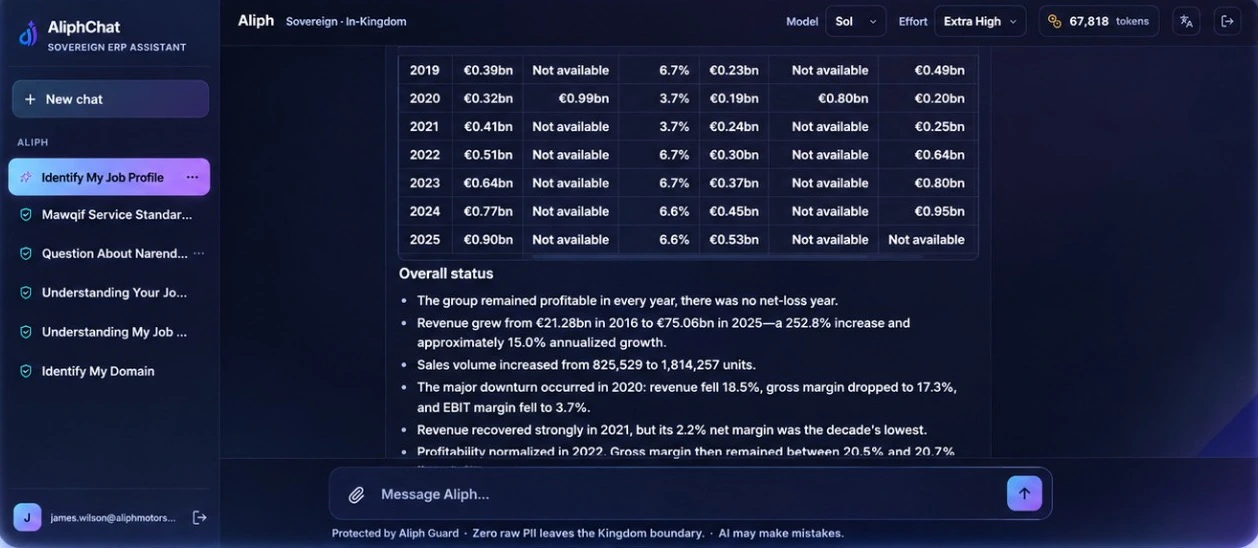
An institution wants employees to ask questions across approved policies and selected ERP records. The engagement classifies the sources, agrees a model and deployment profile, and connects the permitted records to AliphChat. Arabic and English test cases cover source attribution, access boundaries and operational questions.

In this illustrative scope, business reviewers assess the answers and the named production owner accepts the release. The receiving team practises investigation, source updates and evaluation before the technical handover is completed.

Saudi developers collaborating on a workstation in a modern office
Illustrative imagery accompanying a proposed workflow.
A practical path

From a defined need to a working process.

Agree the scope, responsibilities and acceptance criteria together. The delivery plan brings business context, implementation and review into the same conversation.

01

Frame the task and authority

Agree the business outcome, source owners, intended users and production decision-maker. Record classification, purpose and the operating constraints that determine the engineering scope.

02

Engineer in the approved environment

Confirm the deployment profile, prepare sources and implement the model, application and integrations. Build Arabic and mixed-language requirements into the workflow and its test cases.

03

Evaluate and authorise

Review useful and difficult cases, source attribution, access boundaries and failure behaviour. Present findings to the customer owners who approve the release and resolve remaining decisions.

04

Train and transfer

Run hands-on operating sessions, complete documentation and confirm the receiving team. Agree how future model, source and permission changes will be evaluated and approved.

What to evaluate

Evaluate task quality, source attribution, Arabic and mixed-language performance, authority boundaries and the receiving team’s ability to operate the system. Production approval remains with the named customer owner.

Connected capabilities

Put the engineering to work in enterprise applications.

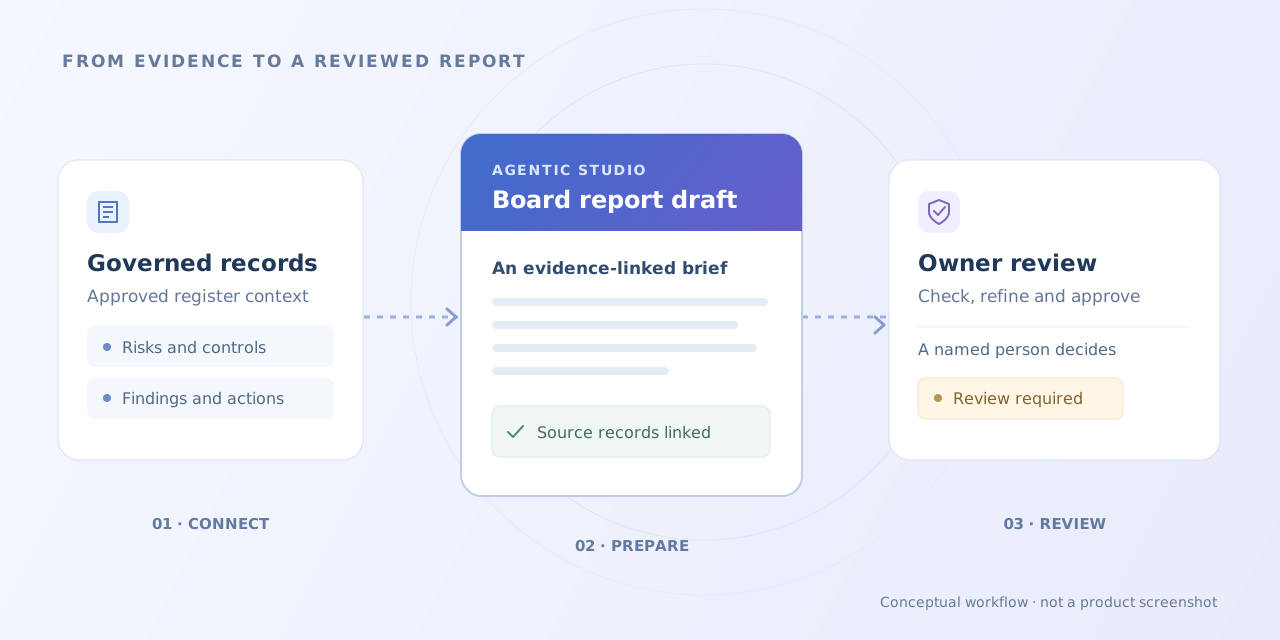
AliphChat connects approved institutional records to conversation. Agentic Studio supports governed drafting and reporting workflows. Product configuration, connectors and deployment are confirmed for the engagement.

A delivery capability for enterprise and partner platforms.

Aliph Data supplies the governed sources and organisational memory; Aliph Cyber defines the authority and egress controls around the AI workflow. Platform engineering also supports partner products such as Utopian. The Utopian page explains Aliph’s technology delivery role and the platform’s venture ecosystem experience.

Frequently asked questions

Plan the next step with a clearer picture.

Does forward deployment mean every system is air-gapped?

No. Classification and customer requirements determine the deployment profile. Some systems need isolated customer-controlled infrastructure; other approved workflows can use governed external services. The design records connectivity, processing locations and permitted data for each path.

Can we use approved open-weight models?

Yes. Model selection considers the task, Arabic and mixed-language quality, infrastructure, operating needs and data classification. Any serving or model-improvement work is scoped within the approved environment and evaluated before release.

Who decides when the system enters production?

Named customer owners authorise access, approve production and decide how residual risks are treated. Aliph provides the implementation, evaluation findings and operational evidence needed for that decision. Release authority is documented in the engagement.

What does the customer team receive at handover?

The agreed handover includes operating documentation, configuration knowledge, evaluation procedures and practical training. It identifies source maintenance, investigation and change responsibilities, with an acceptance process for the team that will run the capability.

MAKE IT WORK

Build the AI your institution can own and operate.

Bring the workflow, data environment and intended users. We’ll define the engineering scope, production decisions and capability your team will take forward.

Start a conversation

Ask Aliph

Aliph products and services

Find your next step with Aliph.

Ask about a product, compare capabilities or explore how our services can support your team.

Enter to send · Shift+Enter for a new line0 / 1,000

Messages are processed by AI. Don’t share confidential information. Answers can be inaccurate. Privacy

This page keeps chat history in memory only.Talk to our team