Aliph Solutions

Data-driven decisions

Make the information behind a decision clear.

Establish ownership, classification and purpose, then connect Arabic and English business records to governed memory, analysis and source-attributed reporting.

Illustrative Saudi analyst reviewing a tablet beside a Riyadh office window
The opportunity

Make the metric meaningful before making it visible.

Aliph Data establishes the shared foundation for information used in AI, governance and security. Begin with ownership, classification and permitted purpose. Prepare Arabic and English records, privacy transformations and business definitions, then connect the resulting organisational memory to analysis, executive insight and reporting that can be traced to its sources.

Shared business definitions

Agree the meaning, calculation and reporting period of each priority measure. Identify who can change the definition and how the change is communicated. Resolve differences such as whether a count includes reopened work, cancelled records or items awaiting approval.

Classified, traceable data flows

Map source records through discovery, transformation and use. Confirm purpose, ownership and classification, including Arabic and English personal data, national identifier and Iqama fields where relevant. Evaluate the selected detection and transformation rules before information reaches a model or analytical destination.

Governed memory and analytical views

Connect documents, decisions and business records to source-attributed organisational memory. Present metrics with the period, scope and definitions needed to interpret them. Where model improvement is included, use an evaluated, owner-approved cycle with release and rollback inside the agreed environment.


Illustrative scenario

Understand the status of outstanding actions.

An operations lead needs a consistent view of outstanding improvement actions across two teams. One team counts items awaiting validation as closed; the other keeps them open. The first step is to agree the status definitions, map each source to them and identify records that need an owner or due date.

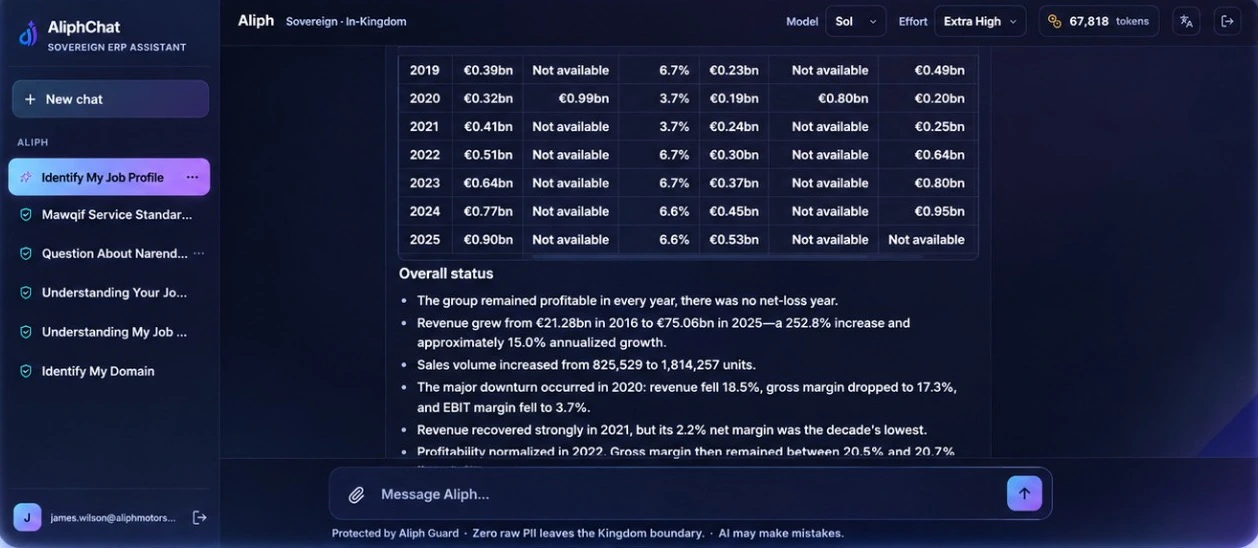
An illustrative analytical view then separates open work from work awaiting validation. Reviewers check sample totals against source records, inspect exceptions and confirm that the view supports a decision about which actions need attention.

Saudi data colleagues reviewing charts together on a large display
Illustrative imagery accompanying a proposed workflow.
A practical path

From a defined need to a working process.

Choose a recurring decision and identify its source records, owners, classification and permitted purpose. Review privacy transformation needs and metric definitions before connecting models or reporting.

01

Frame the decision

Identify the meeting, process or operational decision the work will support. Record the questions people ask and the shortcomings of today’s information.

02

Agree definitions and sources

Confirm measures, source ownership, reporting periods and access. Profile representative data and resolve the quality issues that affect the intended use.

03

Build and reconcile

Implement the agreed flows and views. Reconcile sample results with source records, test refresh behaviour and make exceptions understandable to reviewers.

04

Establish ongoing ownership

Document quality checks, support responsibilities and how changes to definitions or sources are reviewed. Agree how users report a result they cannot explain.

What to evaluate

Check data quality, consistency of metric definitions and whether the result gives decision-makers the context they need.

Frequently asked questions

Plan the next step with a clearer picture.

Do we need a new data platform?

That depends on the sources, required scale and operating needs. Start with the decision and the existing environment. The discovery work should identify what can be reused and where a pipeline, analytical view or platform change is justified.

Can reporting start before all data is perfect?

A focused scope can work with understood limitations. Agree which quality issues prevent the intended decision and which can be made visible. Avoid presenting an incomplete measure as comprehensive, and give unresolved issues an accountable owner.

How does this support an AI initiative?

The same ownership, context, freshness and access decisions help prepare sources for AI-assisted work. Whether a source is suitable for retrieval or another model-assisted task should be evaluated against that specific use case.

What should the team evaluate first?

Check that people interpret the measures consistently, that sample results reconcile to supporting records and that freshness is appropriate for the decision. Ask users to act on a representative result and explain what additional context they need.

MAKE IT WORK

Start with a decision that needs better data.

Tell us about your current process, intended users and requirements. We’ll help define a first implementation and a practical way to evaluate it.

Start a conversation

Ask Aliph

Aliph products and services

Find your next step with Aliph.

Ask about a product, compare capabilities or explore how our services can support your team.

Enter to send · Shift+Enter for a new line0 / 1,000

Messages are processed by AI. Don’t share confidential information. Answers can be inaccurate. Privacy

This page keeps chat history in memory only.Talk to our team